SIMPLY SASHIKO
Classic Japanese Embroidery Made Easy.
By Nihon Vogue
Published by Tuttlepublishing.com
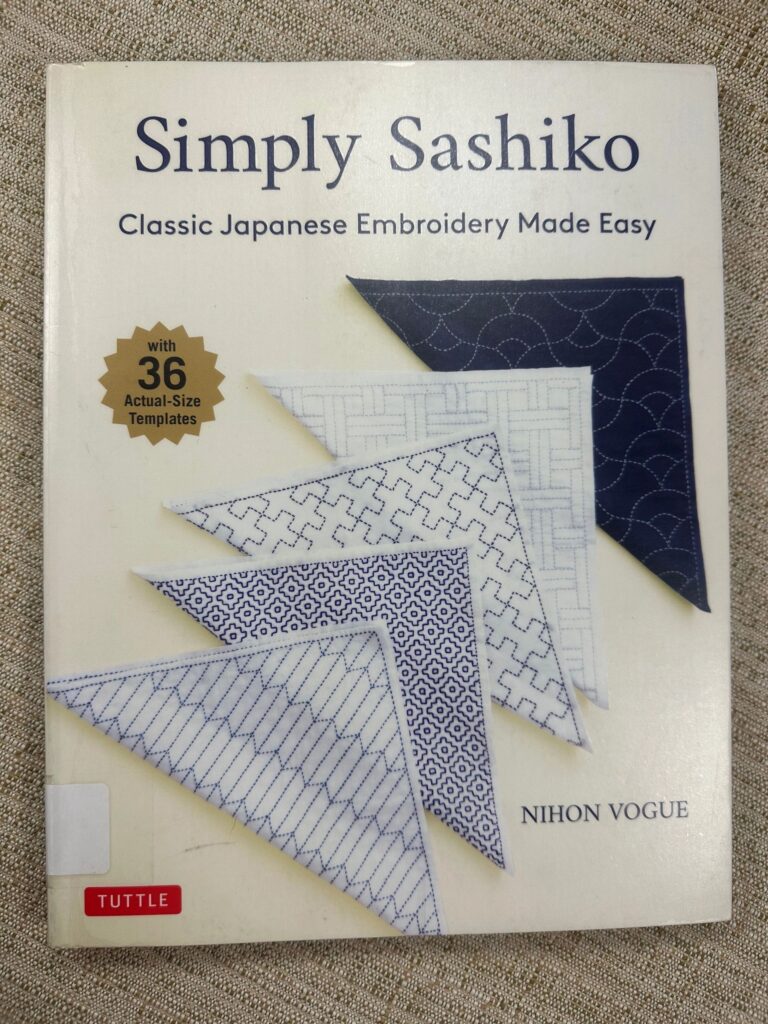
I have been on the lookout for a Sashiko guide to help me get a grasp on a project I want to start and this book ticks all the boxes.Translated from Japanese, it contains heaps of information and instructions on the basics and how to progress from there. The book also showcases practical projects using some of the 36 traditional designs from the book.
My planned project is to decorate a pair of jeans with a mosaic of different Sashiko patterns. This is a substantial project for a beginner, but I love the look of these patterns, and I can keep adding to the project over time until the jeans are absolutely covered. As a beginner to Sashiko, there is a wealth of information available online, on materials, techniques and patterns, but many of these patterns are complex and daunting. How do I tackle a complicated design without stitching myself into a corner? How much thread do I need to not leave me stranded in the middle of my fabric? How can I plan the mix of patterns in a mosaic and keep a co-ordinated look? This book goes a long way to answering my questions.
The basics such a threads and fabrics, tools and transferring designs onto fabric are discussed, including lots of tips and tricks to help make your projects easier. Step by step instructions are provided to show how to stitch these patterns correctly with lots of pictures and diagrams.Caring for your materials and finished pieces is also covered. For someone like me who has not seriously done Sashiko before, these instructions were very clear.
The traditional designs are grouped in families of similar stitches such as straight vertical and horizontal lines, curved lines, hexagonal grids, lattice, etc. Using these "themes", I will be able to create of patchwork of related type patterns in my mosaic to achieve my co-ordinated look. Examples of these patterns have been worked up in various colour combinations of fabric and thread which provide colour sets which I may have overlooked. Some patterns are worked in several different coloured threads so I can trace a single line of stitching through the pattern. Very useful!
The book also contains sewing patterns for the projects showcased. These include a purse, drawstring bag, tote bag, coasters and place mat, tissue cases and brooches.
I was pleased to see that the actual size templates for the stitches are available with their underlying grid pattern. There are also instructions on how to draft your own grid pattern and design to replicate the book. I can trace these designs directly or make my own using a different scale to make a smaller or larger pattern.
Best of all, for each pattern there is a "how to sew" diagram showing which lines to follow to build up the pattern. Do I stitch an outline first? Which vertical line or diagonal should be stitched next? As a beginner, some of the patterns appear to be very complex to stitch. But this book shows how each pattern can be broken down into its basic lines and stitched in a defined order.
After I finish my project, I can pursue some of the other ideas in the book, such as Sashiko using several layers of fabric, trying out Chacopy and Charcopen and using 2 or more colours in a single pattern. This book is a great introduction to Sashiko and the start of another creative journey.
SIMPLY SASHIKO is available on Amazon in paperback for Aus $29.99. Click here to find it on Amazon https://amzn.to/42kyN1t
Disclaimer: This post contains an affiliate link. I may receive a commission from purchases you may make at no additional cost to the buyer. I only recommend products I would use, love and are of good quality. Opinions stated are my own.