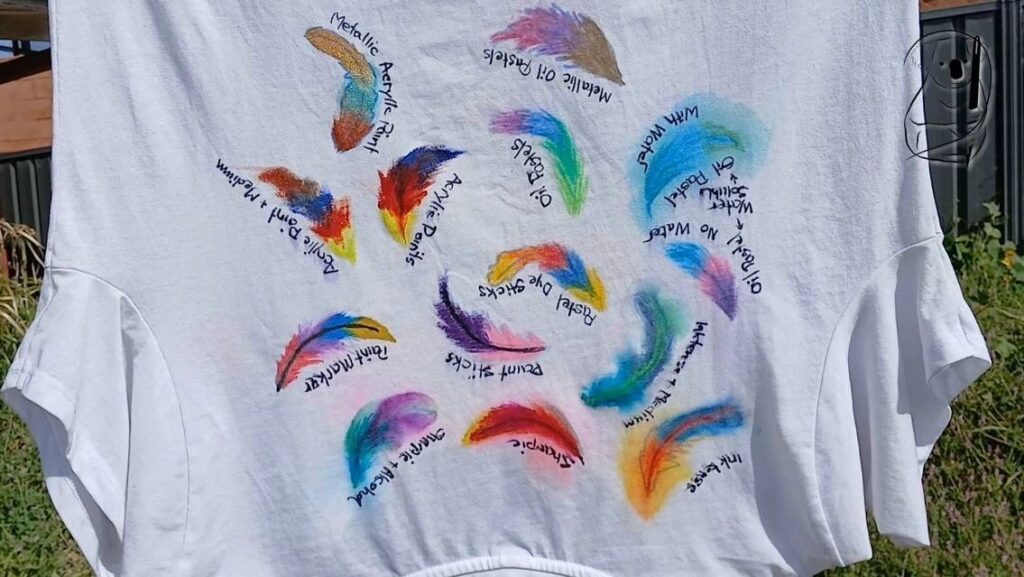
I have always loved painting and drawing on fabric to make some wearable art, and over the years, I've accumulated a few different ways to do this. But apart from the made-for-purpose fabric paints, I wondered what else you could put on fabric, to make your mark and decorate your clothes. And so the great fabric painting experiment was born.
We have already used some of the mediums presented here, but for the sake of completeness (to a point) they have been included again. The results have been interesting, and I am excited to put some of this new information to use.
Watch our video as we test lots of different ways to add colour to fabric.
Inktense Paints - with water
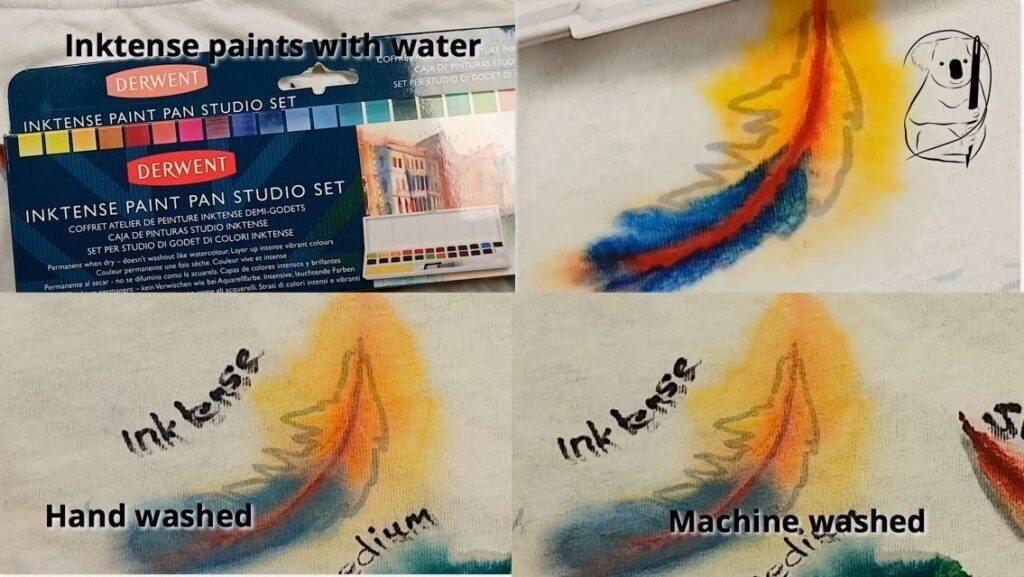
The first to be tested is the Inktense Paints in pans. This paint set has already been used with the detached chain stitch project Cora. When this project was washed a lot of colour was lost, but I have seen other people painting on fabric with these paints, so I wanted to give it another try.
Although there is some colour loss after washing, the colours are still quite strong. So, I did another experiment where I tested all the colours. See further down the page for the results.
Inktense Paints - with acrylic paint medium
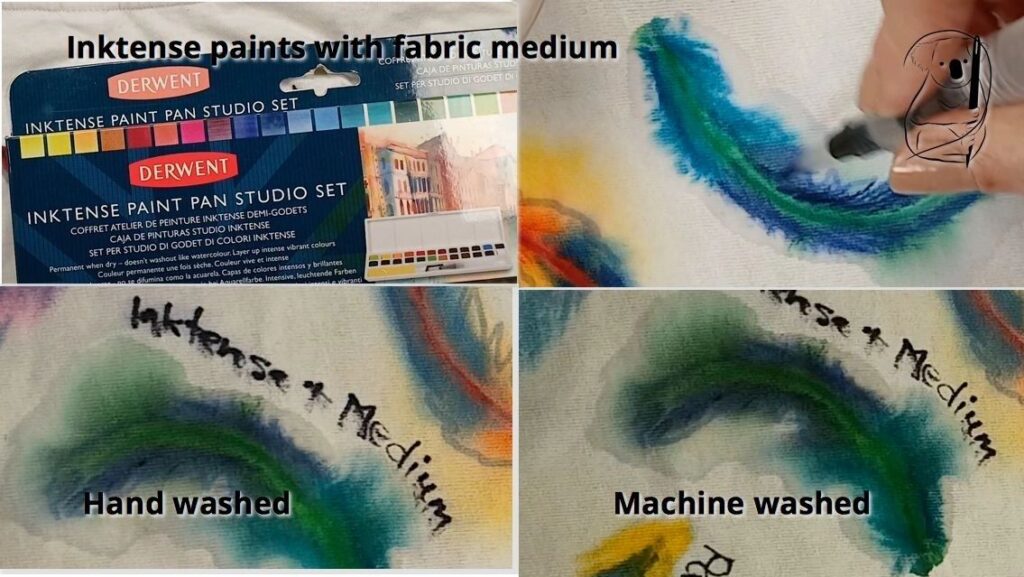
Adding fabric medium to the water when painting with the inktense paint blocks had two obvious effects. Firstly, the colours do appear to be stronger, as though they haven't washed out as easily. Secondly, as a function of this colour retention, there is a clear water mark around the painting. Swings and round-abouts?
Sharpies
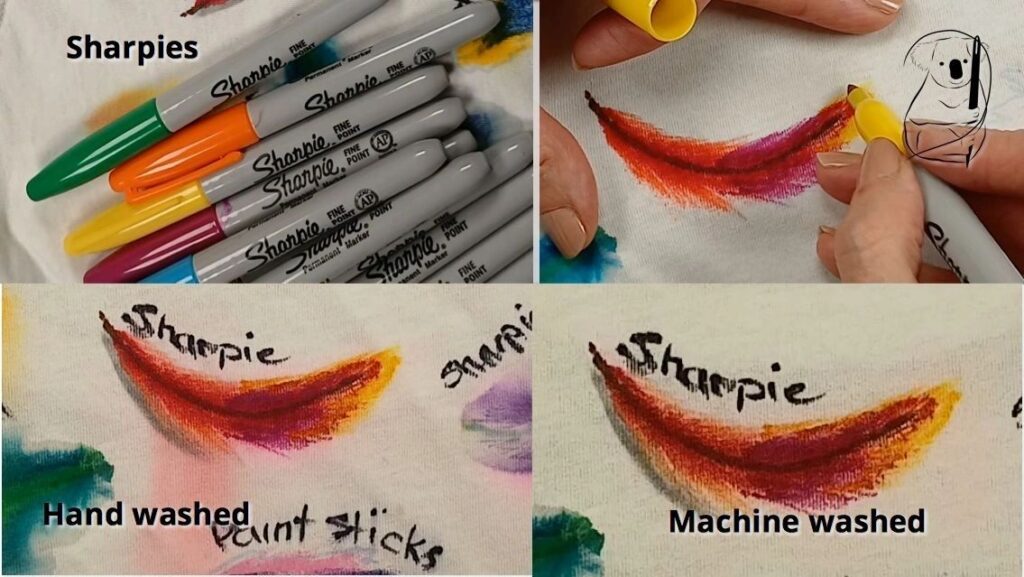
Sharpies are a fun and easy way to add to a garment. Advertised as a permanent marker and alcohol based, I was very surprised to see how much colour came out of the design, and even the writing, in the hand wash. A machine wash with a spin cycle removed most of this colour run. See further down, for a comparison of all the colours, as some run more than others.
Sharpies with isopropyl alcohol
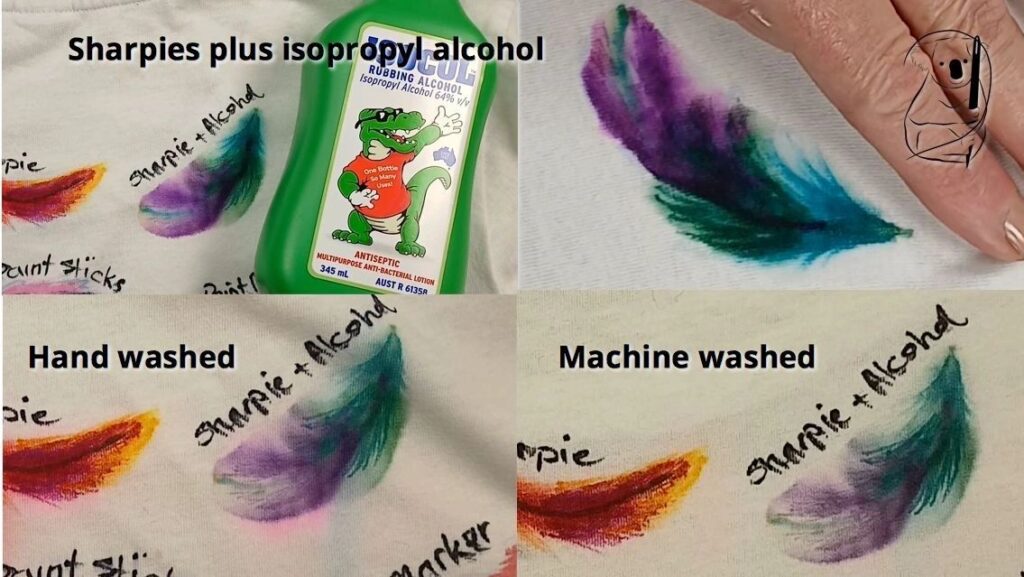
I wanted to get a painterly or water colour effect by spreading the sharpie marks with isopropyl alcohol, and I think to a point, it works. Again, you get a waterline around the original design, but this is an interesting idea to explore.
Acrylic paint markers
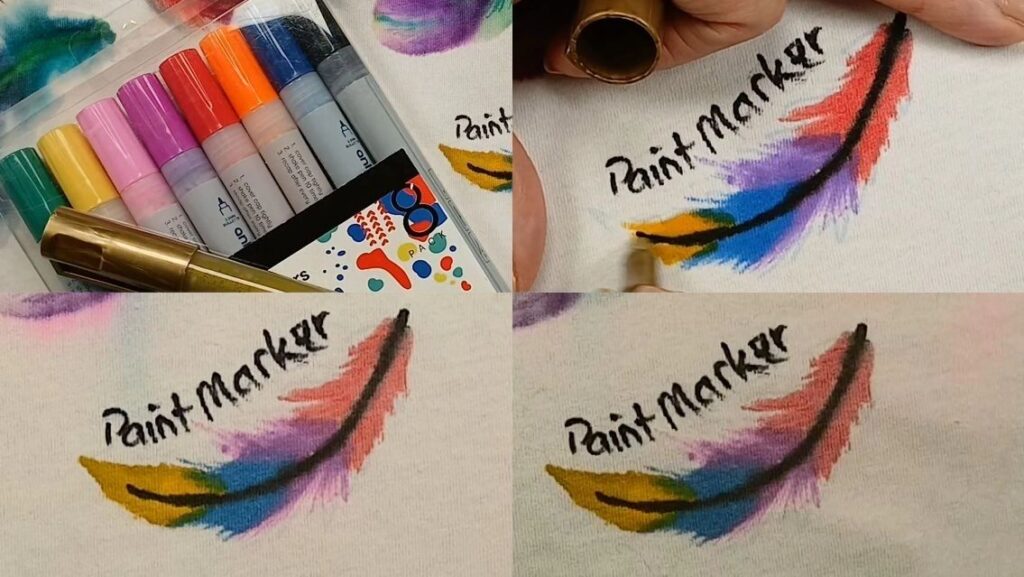
Paint markers are supposed to write on anything, and they write, or draw, very well on fabric. There is some loss of intensity of the colours, but they do remain very strong.
Fabric Paint sticks
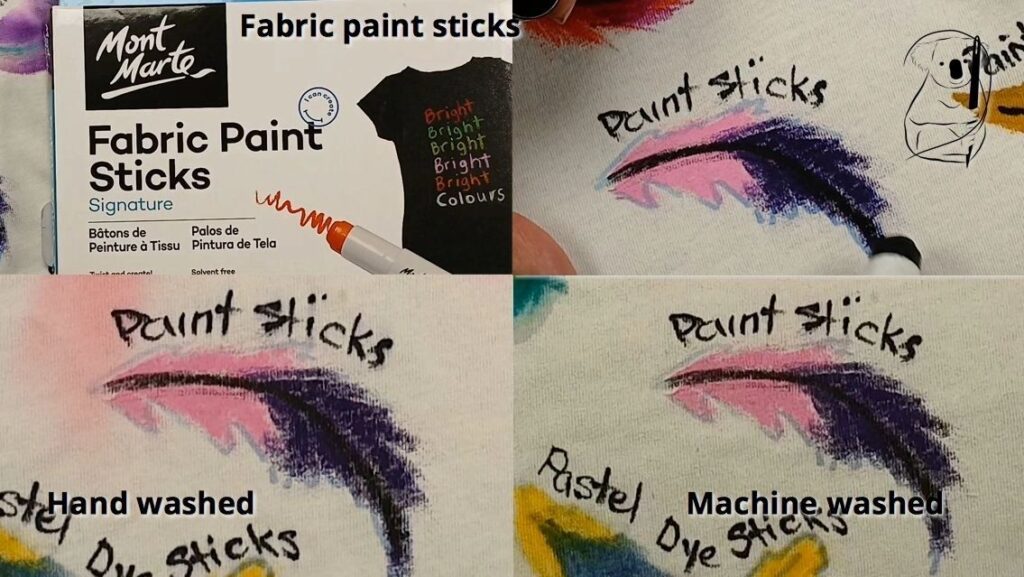
Fabric Paint sticks are a made for fabric painting product, which is designed to be heat treated with an iron before washing. They retained both their intensity and strength of colour after washing. The instructions say to iron (with a piece of paper between the iron and the fabric) for 3 to 4 minutes. The assumption here is that you would have the iron as hot as the fabric can take. Here is another element for further exploration, to see how much different temperatures affect the colour retention.
Pastel Dye Sticks
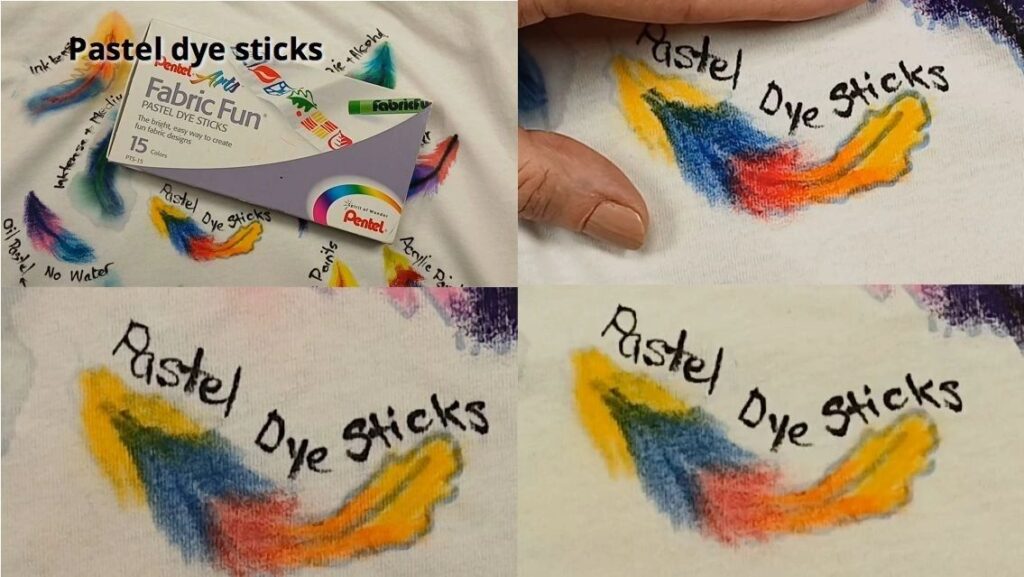
Pastel dye sticks are an oil pastel look alike (which may be what put into my head testing ordinary oil pastels), which are made specifically for drawing on fabric. The instructions recommend cotton as the fabric to colour, warning against wool, wool-blends, nylon or silk. After washing, the colours are softer, but still quite strong.
Water soluble Oil Pastels - no water
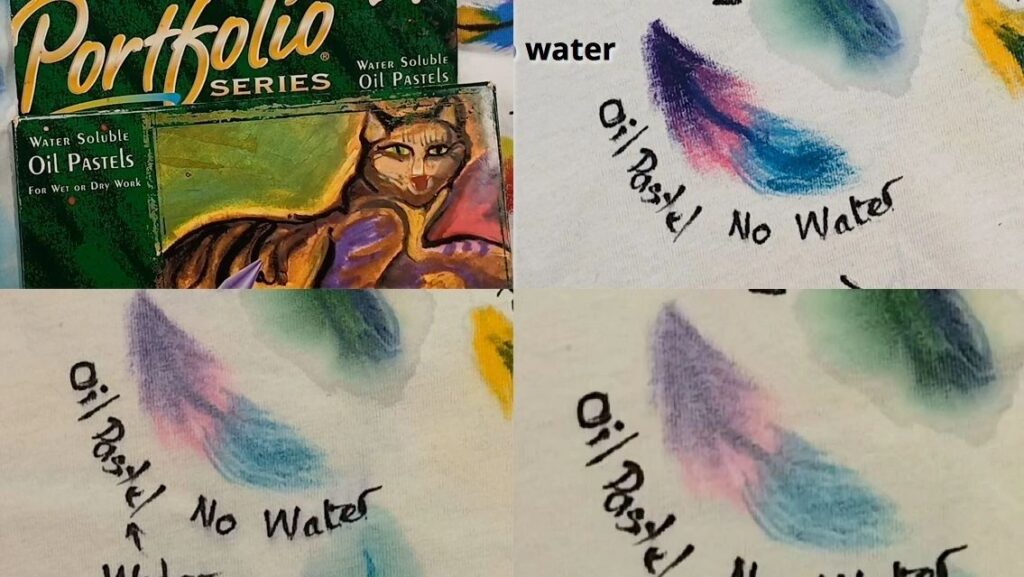
Using oil pastels was a purely speculative activity. While I have been collecting different ways to make marks on fabric for a number of years now, sometimes you just have to work with what you've got or can get your hands on. And so why not try artist materials?
This particular oil pastel is water soluble, and I thought that maybe it would wash right out, but not quite. The effect we are left with makes me think of a design on a t-shirt that has been worn and washed many times, so maybe this is a way to get that vintage t-shirt look?
Water soluble Oil Pastels - with water
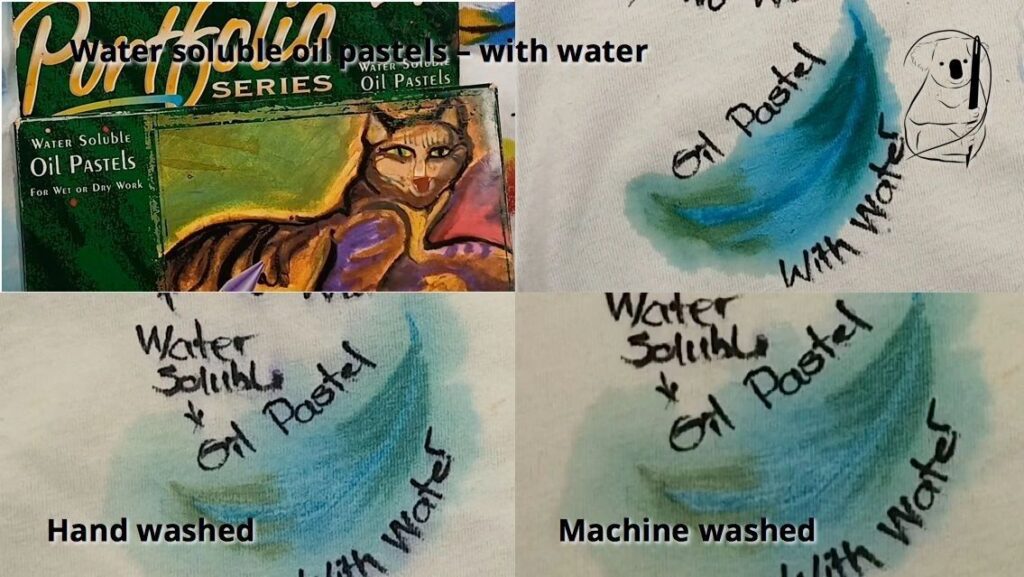
Being water soluble, the obvious thing to do was wet the design before heat setting. Looking at the finished product, I don't think this added anything to the design apart from a watermark of colour, but in a larger composition this might be a useful way to get a watercolour effect.
Oil Pastels
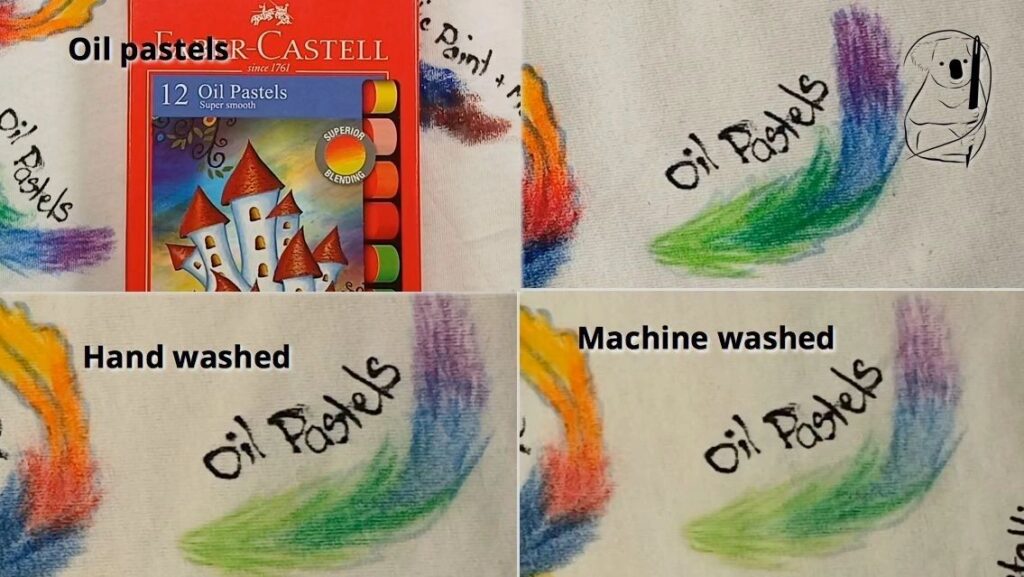
Ordinary oil pastels are easy to source and come in lovely colours. In this experiment, the oil pastels retained almost as much colour as the pastel dye stick. I wonder if better heat setting (longer ironing) might lead to better colour retention.
Acrylic Paint
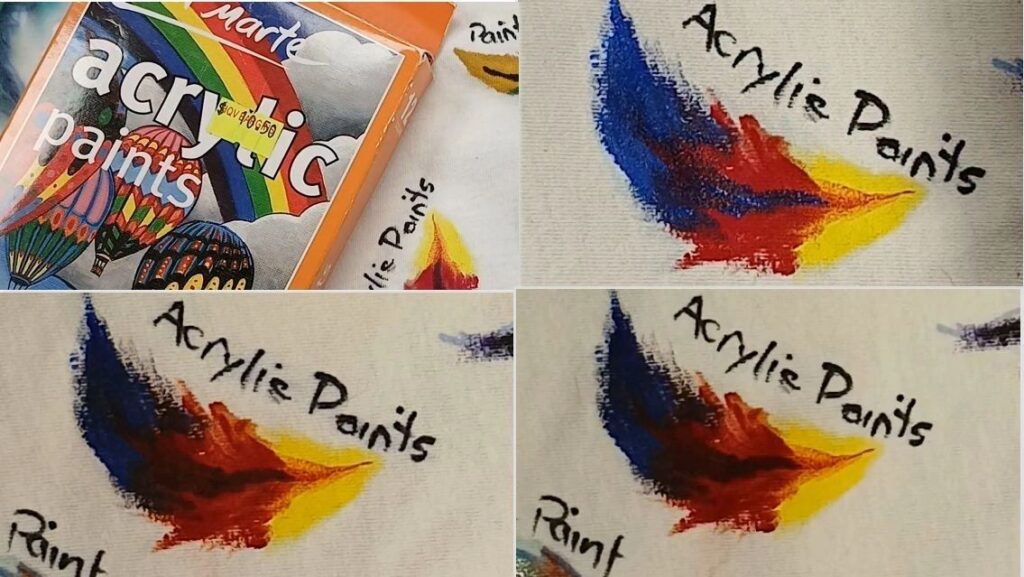
Painting with acrylic paints directly onto the fabric was quite successful. I did iron the design after it was dry, but I'm not certain that this was necessary. Another point to test at a future time. The one caution to note about painting with acrylics is that the paint often dries as a plastic film on the surface of the fabric. (This is similar to the finish found on some commercially produced t-shirts.) If it is too thick, over time, with wear and laundering, this can crack, and spoil the overall effect of the design.
It is still possible to sew through the paint, although it is a little harder than sewing through just the fabric.
Acrylic Paint with Textile medium
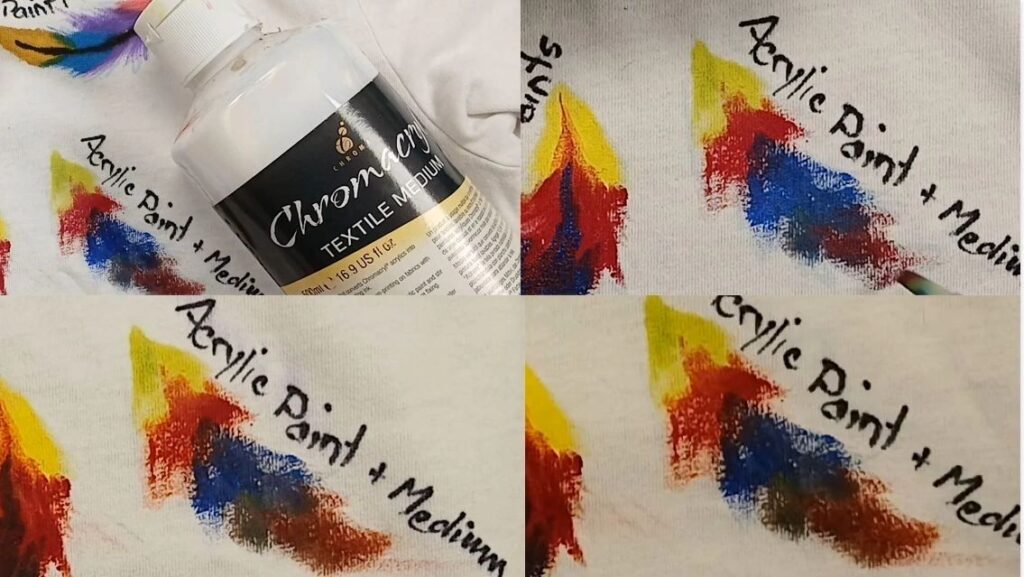
Textile medium takes acrylic paints and converts them into a washable textile paint or printing ink. When dry, the design is fixed with heat.
This example was not a fair demonstration of the use of the textile medium, and I will be doing more with this in the future. The paint did not go on as thickly as the straight acrylic, but the brush was too dry to do justice to the design.
On the other hand, it appears that textile medium can be added to other things (eg Inktense block paints) to make their colours permanent, so perhaps there is more to explore in this direction as well.
Metallic Oil Pastels
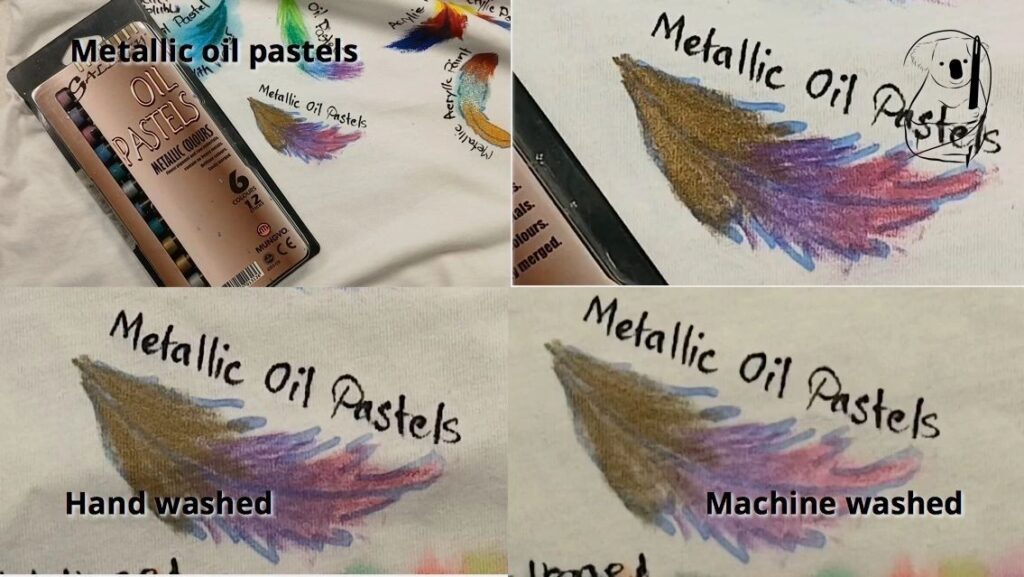
While I was digging through the big box of ways to make marks, I found these metallic oil pastels, and thought to give them a try. On the whole, these were a bit disappointing, because they appeared to lose all their sparkle after washing.
Metallic Acrylic Paints
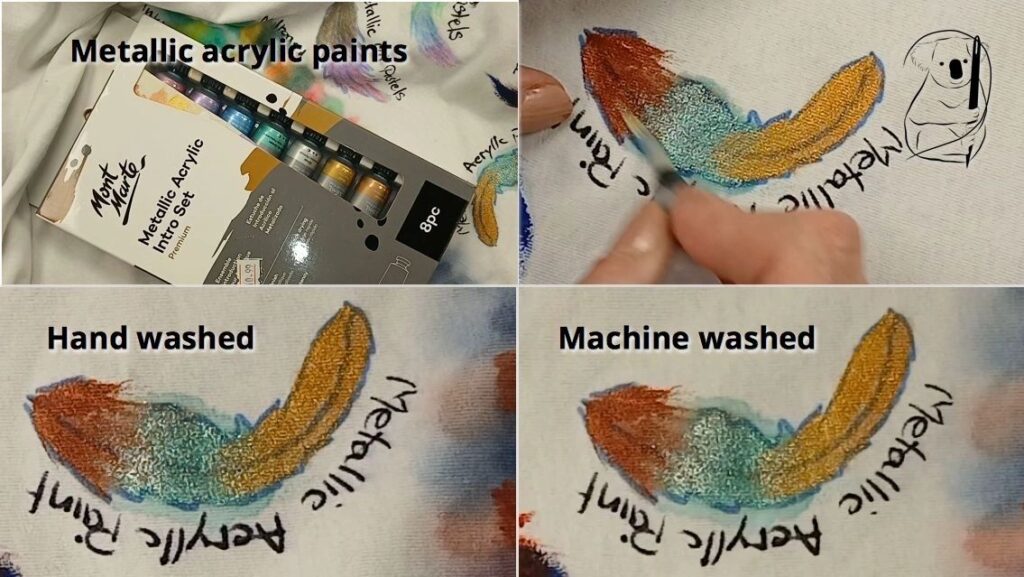
These acrylic paints went on well, and stayed true to their colours. There was some bleeding of colour when the paint was applied - it may be colour specific, and it may be that the brush was wetter for the green. These also dried a bit like a plastic film over the surface of the fabric. Like the ordinary acrylics, this is a little harder to sew through, but not that difficult.
Fabric Crayons
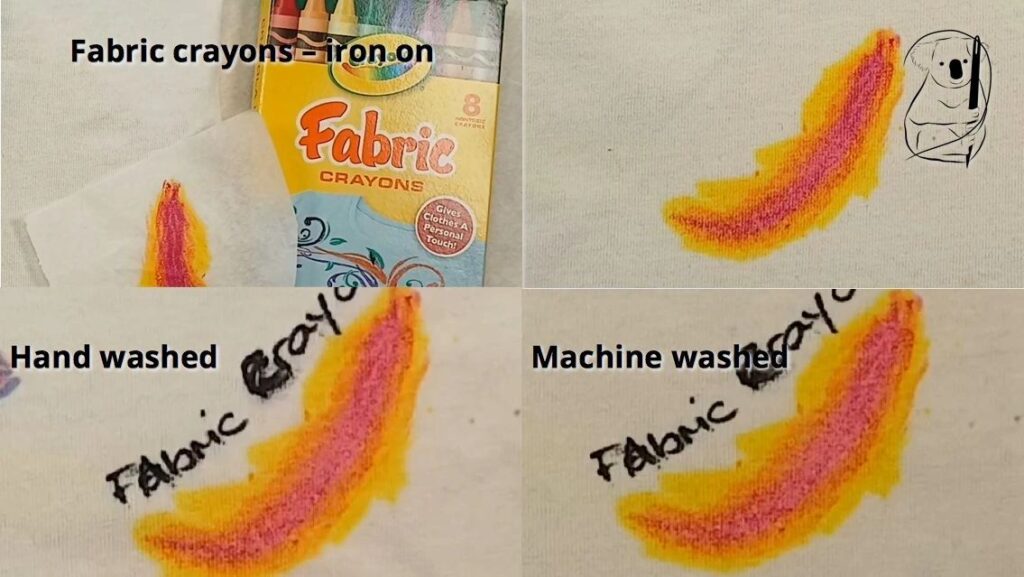
I've had mixed results with these crayons in the past, but for this attempt, I would say that they worked well. Interestingly, the instructions say that the higher the polyester content of the fabric, the better the colour will transfer, recommending 100% synthetic fabric for the best results. When ironing, it is important that the temperature is appropriate to the fabric content, however as the fabric has a layer of paper over it, you can probably raise it just a little.
It is important to protect the underside of the design when ironing, and also the iron itself, as the colour can transfer through the paper toward the iron.
Pigment Markers
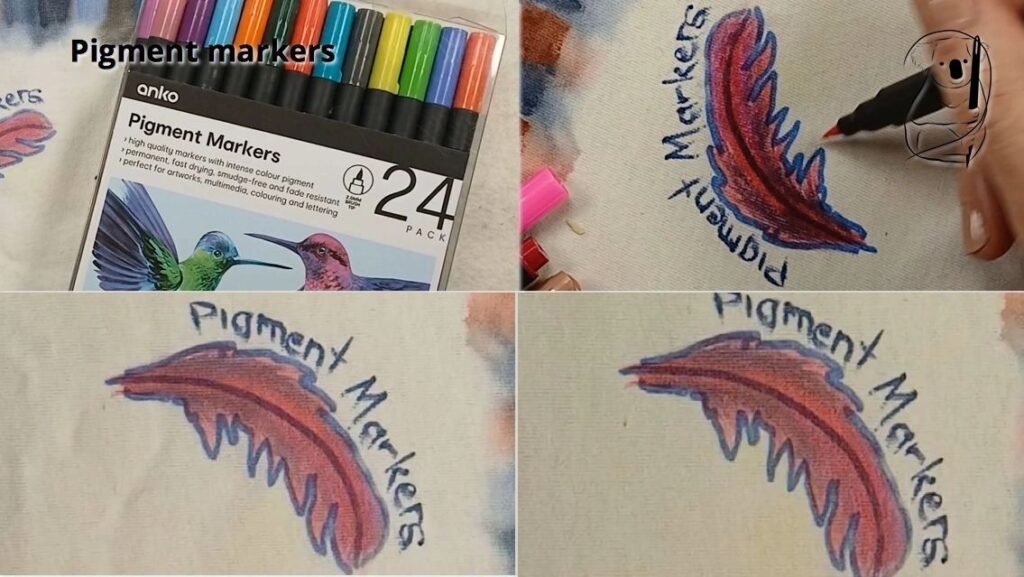
We used the pigment markers to colour the design under the stitching in Stella - the Hibiscus T-shirt. Permanent and fast drying, they were also very easy to blend when working on the t-shirt. I think there was more colour loss in this experiment than with Stella. Reasons for this may be how much pigment was used, the length of time between drawing and washing, or the fibre content of the two shirts.
Hand Wash versus Machine Wash
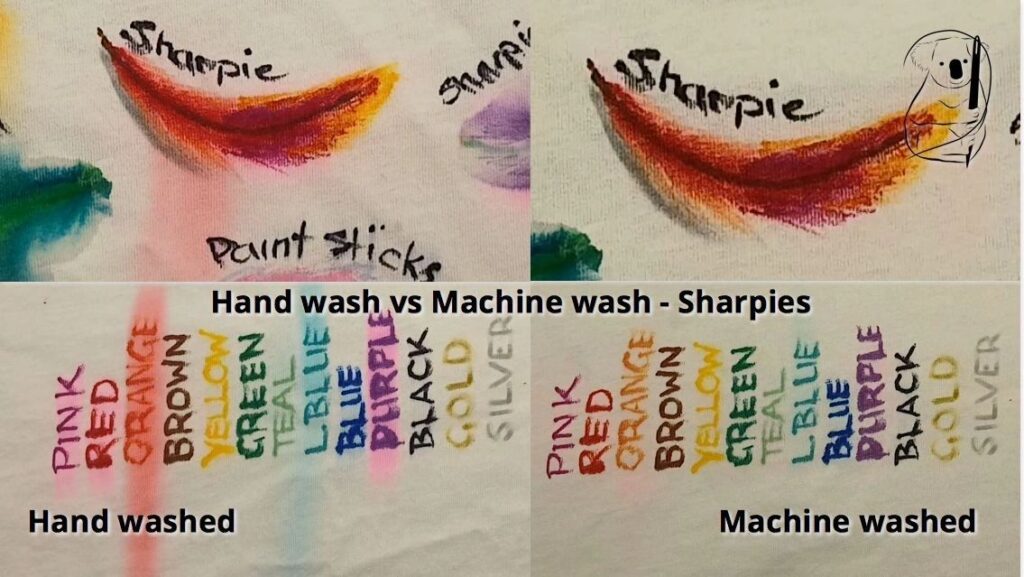
When the sharpies ran after hand washing the small design, I decided that it would be interesting to test all the colours, and I was right. Some colours had a lot of colour run, while others had hardly any at all. And then, after machine washing, the amount of colour remaining varied, not necessarily tied to the amount of original colour run.
The next step in this would be to test how much colour runs when the first wash is by machine.
Heat setting - Inktense
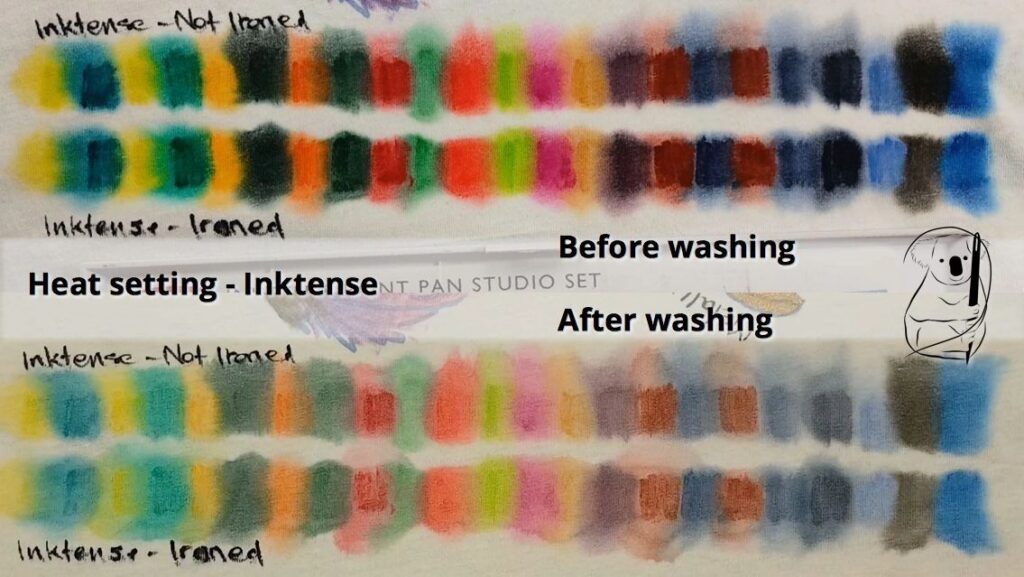
When we used the Inktense paints for Cora, there was a lot of colour loss, more so than in the test design on this shirt. So, I was curious to see if the amount of colour lost was related to which colour was used, and if ironing the paint after it was dry would make any difference. After testing the complete palette, I think it is fair to say that some colours are more colourfast than others, but that ironing doesn't effect how much colour is retained on the fabric.
The high level of colour loss in Cora may be related to the amount of pigment in the design, or perhaps the fibre content of the shirt.
General notes:
These designs were all heat treated together, and may not have been ironed for the length of time recommended by the manufacturer.
All of the products can still be stitched through, although the acrylic paints all left a film on the fabric surface that is a little harder to sew through than the plain fabric.
The main point of this experiment was to play with some ideas, and open up possibilities for ways to decorate the clothes we love to wear. Just because a product wasn't designed for fabric doesn't mean it can't be used this way. That said, it is still important to test things before you commit to a large-scale project. Variations in product brands and fibre content of fabrics can change how products perform, so before you dive in, it pays to test how your combination will perform.
And although this looked like it was a pretty comprehensive test, it is possible that it actually raised more questions than it answered.
And of course, there are products such as fabric paints and fabric markers available as well, which we haven't addressed in this test.
So many ways to add colour to my clothes, so little time.
Watch our video Sephora as we test lots of the different ways to add colour to fabric.
Watch our video - Cora - detached chain stitch and Inktense paints
Watch our video - Stella - A tropical Delight - stitching and pigment markers
Further tests to conduct:
acrylics - ironed and not ironed, straight from tube, thinned with water, thinned properly with fabric medium
Textile medium with other products. Does it work with water colours or poster paints? Metallic acrylics? Pigment markers?
Timed heat setting for paint sticks, pastel dye sticks, oil pastels, metallic oil pastels
Different heat settings for paint sticks, pastel dye sticks, oil pastels, metallic oil pastels
Colour run test for all Sharpie colours, then machine wash.
If you would like to purchase these products you can find some through the following links
1- Derwent Inktense Paints https://amzn.to/4r7i6Rg
2- Sharpies - https://amzn.to/3LLRTaX
3 -Monte Marte Fabric Paint Sticks https://amzn.to/4o0Z2kW
4- Portfolio Series Water Soluble Oil Pastels https://amzn.to/483UUe6
5- Faber Castell 12 Oil Pastels Super Smooth https://amzn.to/43zRsGM
6- Monte Marte Acrylic Paints https://amzn.to/4o0Z9wS
7- - Monte Marte Metallic Acrylics https://amzn.to/44fXmgm
8- Mungyo Metallic Oil Pastels https://amzn.to/3XAljLE
9- Crayola Fabric Crayons https://amzn.to/4oUzCae
This blog uses affiliate links for products we have used in this project. If you purchase one of these products we may receive a small commission at no additional cost to you. Our recommendations are based on personal experience and your experience of the products may differ.